
Jools is a contemporary mixed-media collage artist whose practice engages directly with material reuse, visual appropriation and the psychological weight of images. Working with reclaimed panels, recycled boards, frames and cardboard, she creates layered compositions that exist between painting, assemblage and cultural archaeology.
Her practice draws on Robert Rauschenberg’s integration of image, gesture and recycled material — most notably in his Combines — alongside Rosalie Gascoigne’s use of salvaged materials and weathered surfaces as vessels of meaning. In dialogue with contemporary strategies of appropriation, Jools’s work also resonates with Richard Prince’s interrogation of authorship and cultural memory. Through personal, witty stencilled texts, instinctively shaped by the materials and images she works with, Jools reframes found elements as sites of reflection, humour and critique.
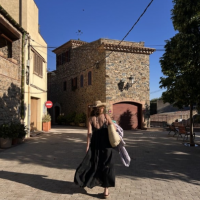
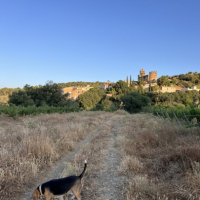
Based in Rabós, a small historic hamlet in the Alt Empordà region of Catalonia, Jools’s practice is shaped by a landscape defined by permanence, restraint and lived culture. Positioned between the Pyrenees foothills and the Mediterranean coast, Rabós sits a stone’s throw from Cadaqués, where Salvador Dalí lived and worked, trading surreal theatrics for a slower, more attentive relationship to material and place.
The cracked stone walls, agricultural rhythms, weathered surfaces and enduring human traces of the region echo the recurring themes that run through her work: memory, erosion and the surreal embedded within the everyday.
Jools’s practice is driven by a spontaneous and playful process. By fragmenting archival mid-century magazines and collaging them with contemporary pop imagery, she draws on whatever recycled materials are available — including, on the occasion, her own wardrobe — to bring texture, humour and personality into each piece. Guided by an ethos of trusting intuition, allowing a single idea to form the centre of a work and grow organically, Jools creates visually rich compositions that invite slow looking and quiet reflection. Her works unfold gradually, rewarding sustained attention and encouraging viewers to encounter memory, culture and material not as fixed or singular, but as layered, evolving spaces.
Leadership is the process of influencing, motivating and enabling others to contribute towards the achievement of a shared goal.
Northouse (2019) defines it as a process whereby an individual influences a group of individuals to achieve a common goal” (p. 5). Similarly, Yukl (2013) highlights leadership as the process of influencing others to understand and agree on what needs to be done and how it can be done effectively. This perspective moves beyond positional authority and emphasises the leader’s ability to shape direction, build commitment and create alignment within a group or organisation.
In practice, leadership is often experienced differently from how it is described in theory. Leaders are required to make decisions with incomplete information, balance competing priorities and manage interpersonal dynamics in real time. Influence is not always formal, motivation is not always consistent and alignment is often difficult to sustain. From a practitioner perspective, leadership involves navigating ambiguity, building trust under pressure and maintaining direction despite changing conditions.
Leadership behaviours are the observable actions and conduct through which leaders exert influence and express their style. They represent the how of leadership in practice and provide a lens for understanding whether leadership is effective or ineffective.
Katz (1955) identified three essential categories of leadership behaviour: technical skills (task expertise), human skills (interpersonal competence) and conceptual skills (strategic thinking). Later, Blake and Mouton’s (1964) Managerial Grid conceptualised leadership behaviours along two axes: concern for people and concern for production.
Contemporary perspectives view leadership behaviours as flexible and situational. Yukl, Gordon, and Taber (2002) proposed a taxonomy of task-oriented, relations-oriented and change-oriented behaviours, emphasising that effective leadership requires a balance depending on context. Moreover, behavioural expressions underpin modern leadership theories; for instance, transformational leaders display behaviours such as inspirational motivation and intellectual stimulation (Bass, 1985), while authentic leaders demonstrate transparency and ethical conduct (Walumbwa et al., 2008).
In practice, leadership behaviours are rarely applied in isolation and are shaped by real-time demands, organisational pressures and interpersonal dynamics. Leaders often shift between task, relational and change-oriented behaviours as situations evolve, requiring judgement and adaptability. As a result, effective leadership is less about applying a single approach and more about responding appropriately to context.
A leadership style refers to the distinctive way a leader applies influence, exercises authority and interacts with their team. It represents the behavioural pattern or approach leaders use when guiding, motivating and managing others.
This concept can be traced back to Lewin, Lippitt, and White’s (1939) seminal work, which categorised leadership behaviours into autocratic, democratic and laissez-faire styles.
Over time, additional frameworks have refined the concept of leadership style. Burns (1978) introduced the distinction between transactional and transformational leadership, which Bass (1985) later expanded into the Full Range Leadership Model.
More recently, authentic leadership has emerged, defined as “a pattern of leader behaviour that draws upon and promotes both positive psychological capacities and a positive ethical climate” (Walumbwa, Avolio, Gardner, Wernsing, & Peterson, 2008, p. 94).